Isolated power supply systems are essential in ensuring electrical safety and continuous power availability in critical care environments such as operating rooms and intensive care units.
Conventional isolated power systems, as defined by the AS/NZS 3003 and AS/NZS 4510 standards, provide two alarm functions: one indicating when the prospective hazard current exceeds safe thresholds, and another alerting when the isolation transformer is overloaded. While these functions are essential for regulatory compliance, they offer limited visibility into overall system performance and fault conditions. As a result, medical and technical personnel may experience difficulty in quickly identifying and resolving faults, particularly when attempting to locate faulty equipment.
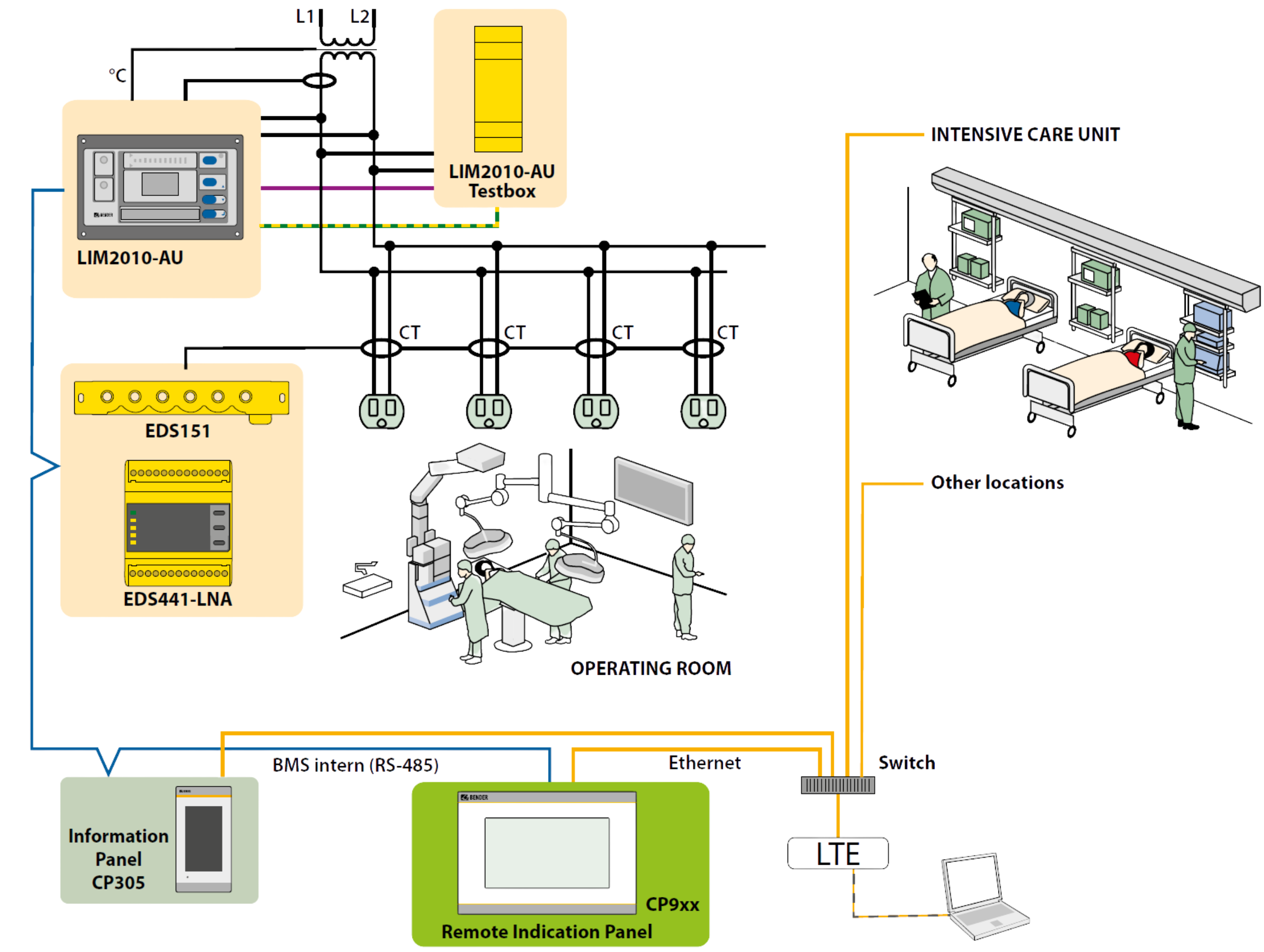
Smart isolated power supply systems overcome these limitations by integrating advanced monitoring and information technologies. In addition to measuring total prospective hazard current and isolation transformer load, these systems provide realtime monitoring of prospective hazard current and load current at individual socket outlets, enabling automatic identification of circuits connected to faulty equipment. Furthermore, alarms and fault conditions are presented in clear, plain-language descriptions, accompanied by guidance for corrective actions. This approach enhances situational awareness, allowing faults to be identified automatically and resolved more quickly and efficiently, while reducing the operational burden and stress on medical and technical personnel.
Smart Isolated Power Supply System
Based on Bender’s state-of-the-art monitoring technology, the Smart Isolated Power Supply System is designed to continuously monitor prospective hazard current and transformer load in accordance with the requirements of AS/NZS 3003:2018 and AS/NZS
4510:1999. In addition, the system monitors individual socket outlet for overload conditions and earth faults, allowing automatic identification of circuits connected to faulty equipment. Detailed fault information is displayed to both clinical and technical personnel, clearly identifying the nature and location of the fault and providing guidance on the appropriate action to be taken.